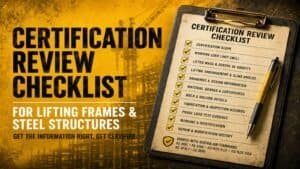
Certification Review Checklist for Lifting Frames and Steel Structures
A practical certification review checklist for lifting frames and steel structures, covering the drawings, WLL, load data, material records, weld...
Read More → 

If your lifting frame is used to lift equipment, connect to a crane hook, support a suspended load, or go onto a mining, construction, manufacturing or industrial site, there is a strong chance it needs engineering certification before it is used.
The question is not just whether the frame looks strong enough.
The real question is whether you can prove that the lifting frame has been designed, fabricated, inspected, tested and documented for the actual lifting duty.
That proof matters.
A lifting frame is often a simple-looking fabricated item. It may be a beam, a skid, a welded frame, a set of lifting lugs, a spreader frame, a lifting yoke, a handling frame or a custom below-the-hook attachment. But once it is connected to a crane and placed under load, it becomes a critical part of the lifting system.
If it fails, the result is not just a damaged frame. The consequences can include a dropped load, damaged equipment, failed site acceptance, project delay, injury risk, regulator attention, insurance questions and commercial liability.
For manufacturers, fabricators, OEMs, mining suppliers and project teams, lifting frame certification is not paperwork for the sake of paperwork. It is the evidence that the lifting device is fit for its stated purpose.
In most industrial and mining environments, yes. A lifting frame generally needs engineering certification if it is custom fabricated, has lifting lugs or padeyes, is used below a crane hook, has a stated Working Load Limit, is used to lift plant or equipment, has been modified, or is being submitted to a site that requires formal structural sign-off.
Engineering certification confirms that the frame has been reviewed against the relevant Australian Standards, including the intended load case, load path, material assumptions, welds, lifting points, sling angles, testing requirements, marking requirements and documentation requirements.
A lifting frame is any fabricated structure or assembly designed to lift, suspend, support, position or handle a load during a lifting operation.
Common examples include:
If the frame connects to a crane, hoist, hook, shackle, sling or other lifting arrangement, it needs to be treated as part of the lifting system. It is no longer just a piece of fabricated steel. It is a load-bearing device with a defined duty.
That means the engineer needs to understand how the load enters the frame, how it travels through the members and welds, and how it exits through the lifting points.
Many lifting frames look strong. That is not the same as being verified.
A thick beam does not automatically prove capacity. A large weld does not automatically prove the weld group is adequate. A heavy lifting lug does not automatically prove that the lug, pin hole, weld, connected member and surrounding structure can carry the actual sling force.
Certification turns assumptions into evidence.
For a manufacturer, certification helps reduce the risk of a client rejecting the frame after fabrication. For a fabricator, it helps confirm that the steelwork being built has a defensible design basis. For an operator, it helps confirm that the lifting device is suitable for the task. For a project manager, it creates a clear record that can be submitted to a principal contractor, auditor, client or mine site.
Without certification, the project can stall at the worst possible time: when the item is already fabricated, painted, delivered or required for a scheduled lift.
That is when missing drawings, unknown material grades, undocumented weld details and unclear sling angles become expensive.
A lifting frame should be assessed for certification when any of the following apply.
Custom fabricated lifting frames usually need engineering certification because there is no generic manufacturer data proving the capacity of that exact configuration.
If the item has been built for a specific machine, skid, module, plant item or site application, the design needs to be checked for that actual use.
If the frame is marked with a Working Load Limit or rated capacity, that rating needs to be justified.
The rating should be supported by engineering checks, load assumptions, material data, fabrication requirements, inspection records and, where required, testing or alternative verification.
Frames with multiple lifting points need careful assessment because load sharing is rarely perfect.
AS 4991 requires the capacity of each load attachment point to account for the share of load that can foreseeably be imposed on it, including unequal load sharing caused by the rigidity or flexibility of the load. In practice, this means the engineer cannot simply divide the load equally between four lugs and call the job done.
The centre of gravity, sling arrangement, frame stiffness, lifted item stiffness and fabrication tolerances can all change how much load each point receives.
Lifting lugs and padeyes are often the most critical part of the frame.
A lifting lug may need to be checked for pin bearing, net section tension, shear-out, tear-out, local bending, weld group capacity, lug plate capacity, connected member capacity and the way load spreads into the supporting frame.
Small changes can make a large difference. A different shackle pin diameter, lug thickness, hole size, weld size, sling angle or load direction can change the capacity of the system.
A crane can be certified and still be used with an uncertified lifting frame.
The crane, hook, rigging gear and lifting frame each need to be suitable for their part of the lift. The certification of the crane does not automatically certify the below-the-hook device attached to it.
Mining, construction, energy, manufacturing and industrial sites often require engineering certification before lifting devices are accepted on site.
This requirement may come from site safety systems, procurement specifications, client requirements, audit processes or internal risk controls.
In practical terms, if the frame is going to a regulated site, expect to be asked for documentation.
Modifications can invalidate previous certification.
Adding lifting points, changing lug geometry, changing welds, increasing the WLL, changing the lifted item, modifying the frame, changing the sling arrangement or using the frame for a different load can all trigger the need for re-certification.
A lifting frame certified for one item of equipment is not automatically certified for another.
The new load may have a different mass, different centre of gravity, different load distribution, different attachment points, different dynamic effects or different sling angles.
Even a lighter load can overload part of the frame if the load path changes.
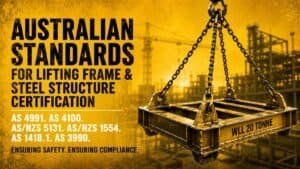
The applicable standards depend on the item, the lifting arrangement, the project specification and the certification scope.
For many custom lifting frames, AS 4991 is the primary starting point because it addresses lifting devices. However, lifting frame certification often needs more than one standard. The frame may also need structural steel checks, fabrication documentation, welding controls, crane interface checks and material traceability.
| Standard | Why it may be relevant |
|---|---|
| AS 4991:2004 – Lifting devices | Primary reference for many below-the-hook lifting devices, including lifting beams, lifting frames, lifting attachments and related equipment. It is highly relevant to risk assessment, design basis, proof loading, marking, inspection and maintenance. |
| AS 1418.1:2021 – Cranes, hoists and winches, Part 1: General requirements | Relevant where the device interfaces with cranes, hoists, winches or crane-type appliances, and where crane load, manufacture, construction, inspection or rated load considerations affect the certification basis. |
| AS 4100:2020 – Steel structures | Relevant for structural steel member and connection design, including bending, shear, compression, buckling, fatigue and design capacity checks for load-carrying steel members. |
| AS/NZS 5131:2016 – Structural steelwork, fabrication and erection | Relevant for fabrication quality, construction categories, welding documentation, inspection and test plans, material traceability, surface treatment, galvanizing, painting and records. |
| AS/NZS 1554 series – Structural steel welding | Relevant for welding requirements. AS/NZS 5131 calls up the relevant part of AS/NZS 1554 for structural steel welding. |
| AS 3990:1993 – Mechanical equipment, steelwork | May be relevant when the lifting frame forms part of mechanical equipment steelwork or when the project specification nominates AS 3990 as the design basis. |
| Applicable rigging and component standards | May be relevant where shackles, slings, eyebolts, hooks, pins or other proprietary lifting components form part of the certified arrangement. |
The correct standard set must be selected for the actual job. A lifting beam, a process skid with lifting lugs, a transport frame and a special-purpose handling frame can look similar in the workshop but require different engineering checks.
AS 4991 is important because it deals directly with lifting devices. For lifting frames, the most relevant parts are usually the general design requirements, the treatment of multiple load attachment points, risk assessment, proof loading, marking, inspection and repair documentation.
One of the most important practical points is that a lifting device is not assessed in isolation from its task. AS 4991 requires a written risk assessment by a competent person before carrying out the operation required by the lifting device. That risk assessment needs to consider the task, the methods available, the device required, hazards, risks, plant, materials, emergency procedures and rescue procedures.
For custom lifting frames, this is a major point. Certification should not be based only on a mass value. It should be based on the real lift.
The engineer needs to know what is being lifted, where the centre of gravity is, how the load is attached, what sling angle is proposed, how many lifting points are active, whether the load is rigid or flexible, whether the frame will be guided by hand, whether people may be near the lift, and whether site conditions introduce additional risks.
A proper lifting frame certification review may include:
For complex lifting frames, finite element analysis may also be used. FEA can help identify local stress concentrations, stiffness effects, load distribution and areas where hand calculations may be conservative or insufficient.
However, FEA is not magic. It still depends on correct load cases, correct boundary conditions, suitable material data, realistic contacts, appropriate mesh density and proper interpretation by a competent engineer.
Send us your drawings, load information and intended lifting arrangement. We will confirm what standards apply, what information is missing, and whether the frame can be certified as-is or needs changes before sign-off.
No. A proof load test does not replace engineering certification.
A proof load test shows that one fabricated item survived one test arrangement under controlled conditions. It does not automatically prove that the design is suitable for every intended load case, sling angle, centre of gravity offset, fatigue condition, local weld detail, or site use case.
AS 4991 includes proof loading requirements for general application lifting devices. For example, the required proof load depends on the Working Load Limit or rated capacity. Up to 10 tonnes, the proof load is 2 times the WLL or rated capacity. From 10 to 160 tonnes, the proof load is based on 1.04 times the WLL or rated capacity plus 9.6 tonnes. Above 160 tonnes, the proof load is 1.1 times the WLL or rated capacity.
The proof load needs to be applied in a manner similar to intended service, with dynamic effects minimized. AS 4991 also includes acceptance criteria around permanent deformation and requires visual or non-destructive examination by a competent person after the test.
That is why testing should not be treated as a shortcut around design. The better pathway is design verification first, then proof testing or alternative verification where required by the standard, project specification or certification scope.
Marking is a common reason lifting frames get rejected at site acceptance.
AS 4991 requires lifting devices to be clearly marked with key information where applicable. For a typical lifting frame, that may include manufacturer identification, model where applicable, identification number, tare mass if the equipment exceeds 50 kg, and Working Load Limit or rated capacity.
If the frame can be used in more than one configuration, the WLL or rated capacity for each configuration needs to be indicated.
For lifting beams, AS 4991 also requires the maximum permissible included sling angle applicable to the design of the spreader or combination beam to be stated where applicable.
This is critical. Sling angle changes the forces in the frame. A lifting beam designed for one sling angle may not be suitable for another. The marking should make the allowable configuration clear to the people using the device.
A good certification package should therefore not just say “certified.” It should define exactly what configuration is certified.
The fastest certification jobs are the ones where the design basis is clear from the beginning.
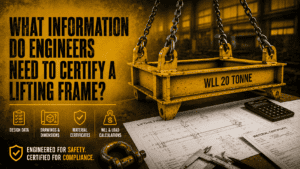
For a lifting frame certification review, we typically need:
Do not worry if you do not have every item. Part of the certification process is identifying what is missing and what needs to be confirmed before sign-off can be issued.
We provide independent structural certification for lifting frames, lifting lugs, spreader beams, fabricated steel structures and handling equipment across Perth and regional Western Australia.
Book a quick call and we will confirm what standards apply, what information we need, and the likely pathway to certification.
Not every lifting frame needs the same level of engineering review, but custom fabricated lifting frames, modified frames, frames with lifting lugs, frames with a stated WLL, and frames used on mining or industrial sites usually require engineering certification or equivalent engineering evidence.
AS 4991 is commonly relevant for lifting devices, but the correct design basis depends on the item and the project requirements. Other standards may also apply, including AS 4100, AS/NZS 5131, AS/NZS 1554, AS 1418.1 and AS 3990 where relevant.
No. A proof load test can form part of the verification evidence, but it does not replace engineering certification. The design still needs to be checked for the intended load case, geometry, materials, welds, lifting points and certified configuration.
Yes, retrospective certification may be possible. It may require measurements, drawings, material verification, weld inspection, NDT, condition assessment and proof testing depending on the available records and condition of the frame.
Modified lifting frames should be reviewed by an engineer before use. Changes to lifting points, welds, lug geometry, WLL, member sizes, rigging arrangement or lifted equipment can change the load path and invalidate previous certification.
Turnaround depends on complexity and the quality of information provided. Certification is usually faster when drawings, load data, material grades, weld details, centre of gravity information and lifting arrangements are available at the start.
Send the drawings, lifted load mass, WLL required, centre of gravity, lift point locations, proposed sling arrangement, material grades, weld details, photos, proof test records, NDT records and any site or client specifications. The review can still begin if some information is missing.