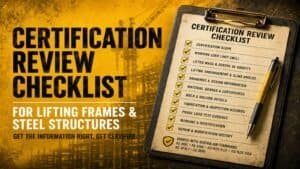
Certification Review Checklist for Lifting Frames and Steel Structures
A practical certification review checklist for lifting frames and steel structures, covering the drawings, WLL, load data, material records, weld...
Read More → 
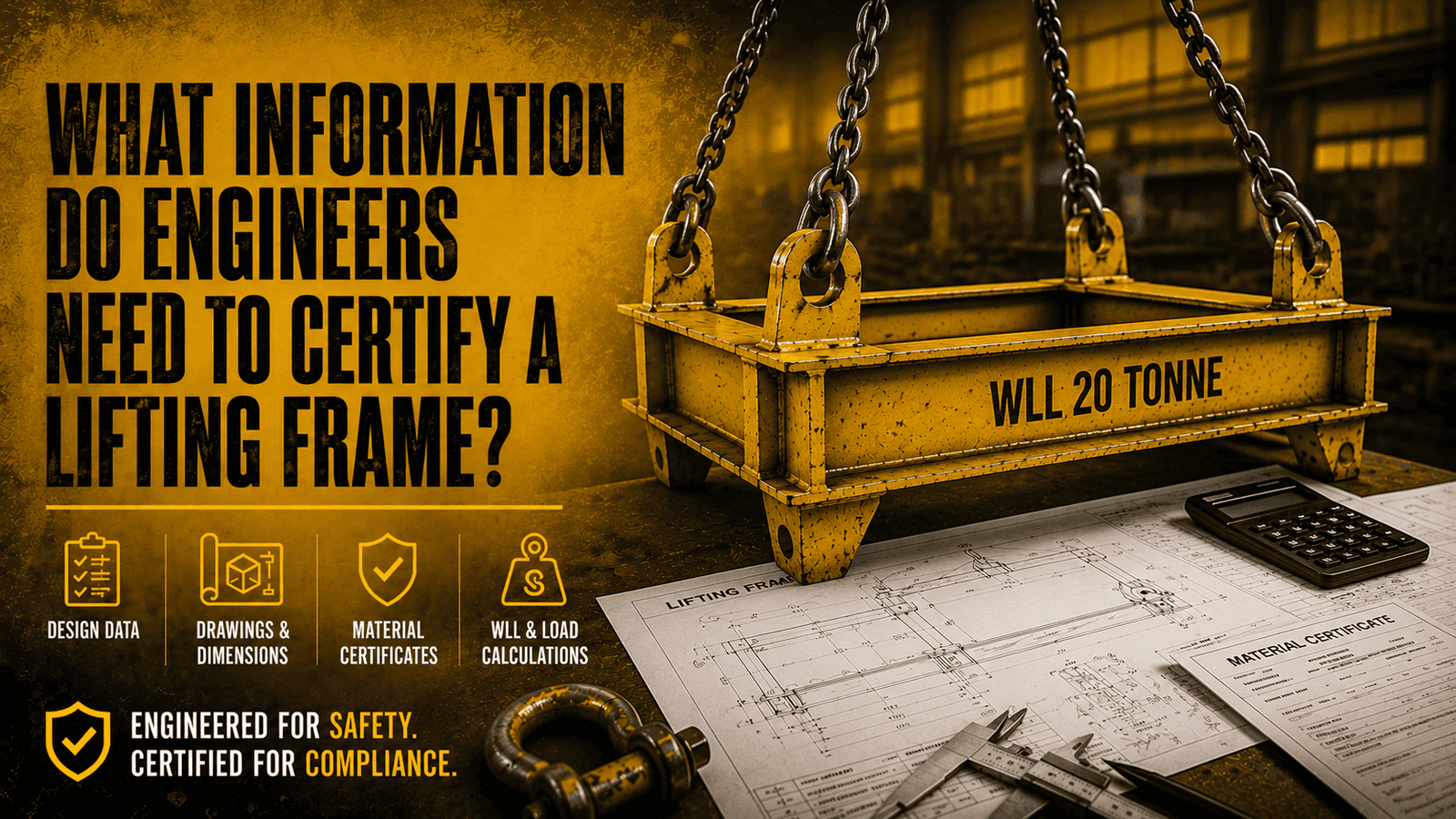
To certify a lifting frame, an engineer needs more than a photo, a rough sketch and a target Working Load Limit. The certification process needs enough information to verify the load path, lifting configuration, material properties, weld details, fabrication quality, proof testing, markings and inspection records for the actual lifting device being assessed.
A lifting frame is part of a load handling system. Once it is connected to a crane, hoist, hook, shackle, sling or lifting beam arrangement, the certification basis needs to be clear and traceable. The engineer must understand what the frame is intended to lift, how the load is applied, what the frame is made from, how it was fabricated, how it will be marked, and what evidence exists to confirm the fabricated item matches the design.
This guide explains the information engineers commonly need when certifying a lifting frame, spreader frame, lifting beam, skid frame, lifting lug arrangement or other below-the-hook lifting device. It is written for fabricators, manufacturers, equipment suppliers, project managers and site teams who want to submit the right information the first time.
Engineers usually need the drawings, design load, Working Load Limit or rated capacity, lifted item mass, centre of gravity, lift point locations, sling angles, rigging arrangement, material grades, weld details, bolting details, fabrication records, inspection records, proof load test data, marking requirements and any repair or modification history.
The more complete the information pack is, the easier it is to define what is being certified and what assumptions apply.
Engineering certification is not just a statement that a lifting frame “looks strong enough.” It is a formal review of the lifting device against a defined scope, a defined load case and a defined set of standards.
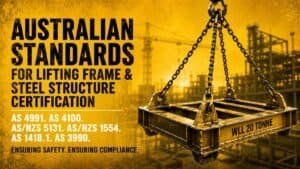
For lifting devices, AS 4991 is normally one of the key standards considered. It includes requirements around testing and verification, proof loading, equipment markings, inspection, maintenance and repair. For steel lifting frames, other standards may also be relevant, including AS 4100 for steel structures, AS/NZS 5131 for structural steelwork fabrication and erection, AS/NZS 1554 for welding, AS 1418.1 for crane-related requirements and AS 3990 where mechanical equipment steelwork is the selected design basis.
Each standard depends on information. A proof load cannot be nominated without knowing the Working Load Limit or rated capacity. A weld cannot be checked without knowing its size, type and location. A lifting lug cannot be checked properly without knowing the load direction, hole size, plate thickness and shackle interface. A steel member cannot be checked without knowing its section size, material grade, restraint condition and applied forces.
That is why the information requested by the engineer is not administrative. It forms the evidence base for certification.
The exact information required depends on whether the frame is new, already fabricated, modified, repaired, proof tested, or being certified for a new use. However, most certification reviews need the categories below.
The first thing an engineer needs is the certification scope. This answers a basic but important question: what exactly is being certified?
AS 4991 uses Working Load Limit or rated capacity as the basis for proof loading and marking requirements. The engineer needs to know the intended WLL before any meaningful assessment can occur.
The total suspended load must be understood before certification can proceed.
Centre of gravity affects load distribution between lifting points and sling legs.
Sling angles can significantly increase forces on lifting lugs and welds.
Drawings are one of the most important parts of the certification process. A lifting frame cannot be properly certified from a photograph alone.
The engineer needs enough dimensional information to understand the load path, member sizes, plate thicknesses, weld locations, hole sizes and connection geometry.
AS/NZS 5131 requires shop detail documentation to accurately transfer information from the construction specification and provide dimensional information suitable for fabrication and inspection.
For certification, this means the engineer usually needs:
Important: if the lifting frame has already been fabricated and the drawings do not match the actual item, the engineer may require as-built drawings or additional measurements before certification can continue.
Material traceability is a critical part of lifting frame certification.
AS 4100 and AS 3990 both rely on material properties to determine design capacity. AS/NZS 5131 also requires material documentation and traceability systems for structural steelwork fabrication.
The engineer typically needs:
If material certificates are missing, additional verification or conservative assumptions may be required.
Welds are often the most highly stressed parts of a lifting frame.
AS/NZS 5131 and AS/NZS 1554 include requirements around welding procedures, welder qualifications, inspection and fabrication control.
Engineers usually need:
AS 4991 includes proof loading requirements for general application lifting devices. The proof load depends on the Working Load Limit or rated capacity.
Where proof testing has already been completed, the engineer usually needs:
Send your drawings, proof load test records, photos or fabrication documents through the contact page and we will review what information is missing before certification proceeds.
AS 4991 requires lifting devices to be clearly marked with relevant information.
Depending on the lifting device, this may include:
Incorrect or missing markings are one of the most common reasons lifting devices are rejected at site acceptance.
AS 4991 requires inspection records to be maintained for lifting devices and includes guidance around repair records and competent person inspections.
For existing lifting frames, engineers may request:
If a lifting frame has been modified, repaired or overloaded in the past, that information should be disclosed before certification proceeds.
You do not need a perfect documentation pack before contacting an engineer.
The best starting point is usually:
From there, the engineer can identify what additional information is required.
Certification delays usually happen because key information is missing or inconsistent.
Common examples include:
Providing complete information early usually reduces certification delays and reduces the risk of redesign or rework.
We provide lifting frame certification, lifting device sign-off, proof load review and structural certification support across Australia.
The most important starting information is the Working Load Limit, lifted item mass, centre of gravity, lift arrangement, sling angles, drawings, material grades and weld details.
Sometimes, but the engineer will usually need detailed measurements, photographs and additional inspection information before certification can proceed.
If proof testing has already been completed, the records should be provided. Depending on the certification scope and applicable standards, additional testing or verification may still be required.
Material certificates provide evidence that the steel used in the fabricated item matches the material properties assumed in the design calculations.
Modified lifting frames should be reviewed before use. Modifications can change the load path and invalidate previous certification.