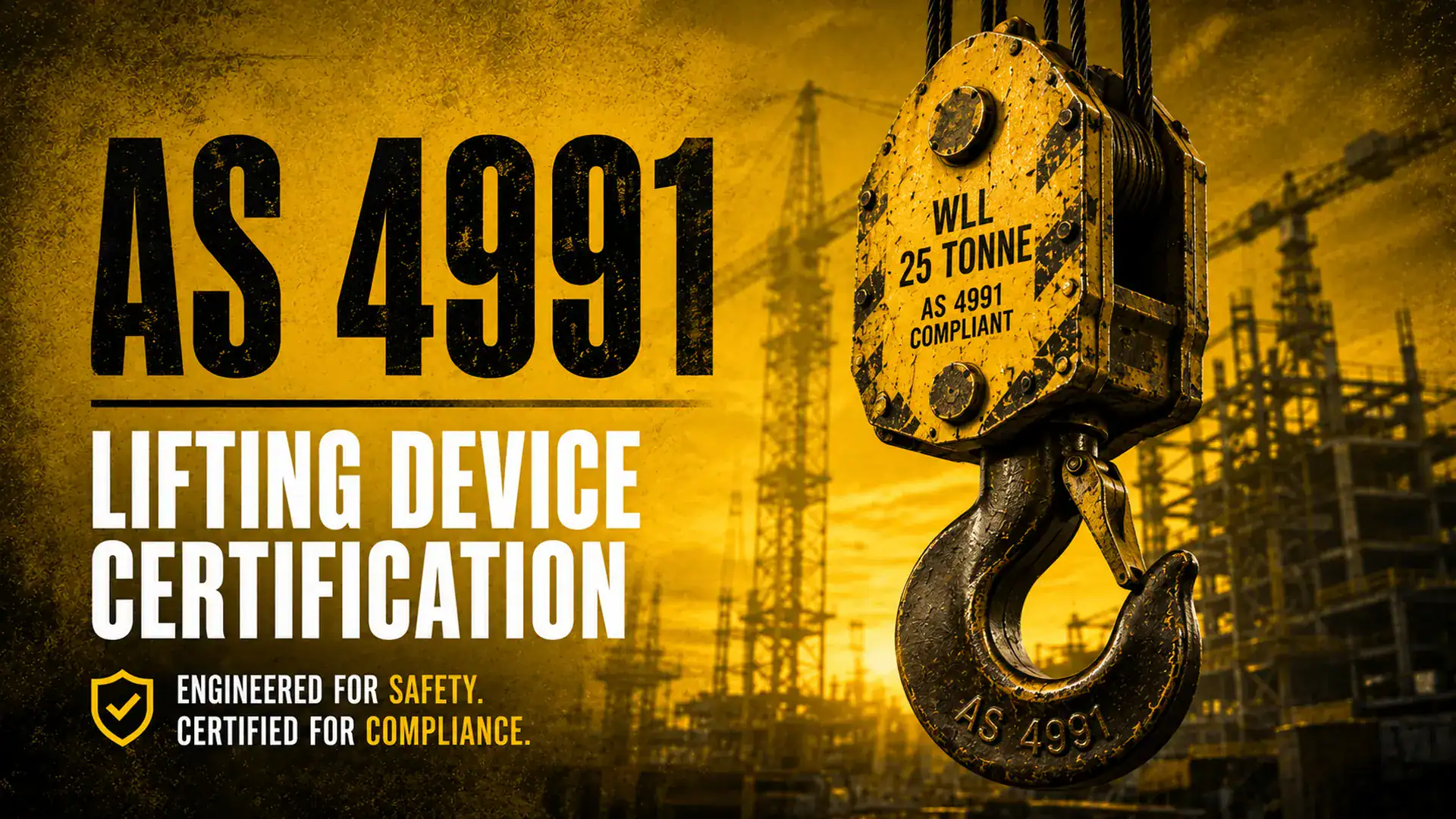
If your fabricated structure is used to lift, suspend, support or handle a load, the question is not simply whether it “looks strong enough”.The real question is whether you can demonstrate, through defensible engineering and documented compliance, that the lifting device has been designed, tested and verified in accordance with the applicable Australian Standard requirements.That is where AS 4991 lifting device certification becomes critical.For fabricators, manufacturers and mining contractors, lifting devices are frequently produced under tight project deadlines. A workshop needs a certified spreader beam before shutdown mobilisation. A manufacturer needs a lifting frame signed off before dispatch. A mining client requests engineering certification before site acceptance.When certification is left until the end of the process, small design assumptions can become expensive problems.A lifting point may be overloaded due to sling geometry. A fabricated beam may not satisfy the required lifting duty. A lifting device may have no documented testing pathway. A site audit may identify missing markings, missing risk assessments or insufficient design verification.These issues create delays, rework, rejected equipment and commercial risk.AS 4991 exists to reduce those risks.AS 4991-2004 specifies requirements for the design, testing, marking and correct care and use of lifting devices that can be fitted directly or indirectly to the hook or another coupling device on a crane, hoist or winch.At Structural Certification, we work with manufacturers, fabricators and industrial operators across Western Australia to provide independent engineering review and certification for lifting beams, spreader beams, lifting frames and fabricated lifting equipment.Our role is not simply to “stamp drawings”.Our role is to identify risk before it becomes a project problem.Why Clients Engage Structural Certification- Reduce risk of site rejection
- Avoid costly post-fabrication redesign
- Demonstrate compliance with AS 4991 requirements
- Provide defensible engineering documentation
- Improve confidence during audits and inspections
- Reduce uncertainty for project managers and procurement teams
Need Fast AS 4991 Certification?
Schedule a quick engineering review call to discuss your lifting frame, spreader beam or fabricated lifting device.
Schedule A Quick Certification Call What Is AS 4991?
AS 4991-2004 is the Australian Standard titled Lifting devices.The Standard was developed by Committee ME-005, Cranes, and its objective is to provide requirements additional to other parts of AS 1418.The Standard applies to a broad range of lifting devices including:- Lifting beams
- Spreader beams
- Bins and skips
- C-hooks
- Lifting forks
- Vacuum lifting devices
- Lifting magnets
- Plate clamps
- Tongs
- Bulk material grabs
- Girder clamps
The contents pages specifically identify dedicated sections for lifting beams, gripping devices, vacuum lifting devices, lifting magnets and lifting forks.The Standard also includes requirements relating to:- Design
- Testing and verification
- Equipment marking
- Maintenance and inspection
- Care and use
- Information supplied with lifting devices
Importantly, AS 4991 does not cover slings, lifting gear, workboxes or equipment already covered by other Australian Standards.Why AS 4991 Certification Matters
Most lifting device failures do not occur because steel “wasn’t thick enough”.Failures usually occur because design assumptions were wrong, loading conditions were misunderstood or operational risks were never properly considered.A fabricated lifting frame might appear extremely robust in a workshop, but that does not automatically mean it satisfies the requirements of AS 4991.For example:- Was unequal load sharing considered?
- Were sling angles accounted for?
- Was the lifting duty correctly defined?
- Were induced horizontal forces considered?
- Does the device require proof testing?
- Has the device been properly marked?
- Has a documented risk assessment been completed?
These are not theoretical concerns.These are the exact issues that commonly delay site acceptance and trigger engineering non-conformance reviews.AS 4991 specifically requires lifting devices intended for general application to withstand:- A minimum design load of 1.5 times capacity
- A proof load in accordance with Section 12
- A minimum of 20,000 lifting cycles
- Induced horizontal forces
These requirements are specified in Clause 2.2.2.For hazardous or dangerous goods handling, including molten metal handling, an additional design multiplication factor of 1.33 must also be applied.That level of engineering rigor is exactly why many mine sites and industrial facilities require documented lifting device certification before equipment can be placed into service.Reduce Risk Before Fabrication
Early engineering review can identify design risks before steel is cut, welded and painted.
Book An Engineering Review Lifting Beams and Spreader Beams Under AS 4991
Lifting beams are specifically addressed in Section 9 of AS 4991.The Standard defines lifting beams as:“Equipment consisting of one or several members equipped with various attachment points in order to distribute the load as required by the characteristics of the handled loads.”This definition commonly includes:- Spreader beams
- Lifting frames
- Transport lifting frames
- Modular lifting assemblies
- Mining lifting beams
- Multi-point lifting structures
One of the most important requirements for these devices is load distribution.Clause 2.6 requires lifting equipment using multiple attachment points to account for unequal load sharing caused by rigidity or flexibility of the load.This is critical in real-world lifting operations because loads are rarely perfectly symmetrical.A small centre-of-gravity offset can significantly increase forces in one lifting point or beam member.That is why lifting beam certification should never rely on assumptions or “rules of thumb”.Defensible engineering review matters.Testing Requirements Under AS 4991
AS 4991 places significant emphasis on testing and verification.Section 12 specifically covers:- General testing requirements
- Proof loading
- Alternative verification
Different lifting devices have different testing requirements under the Standard.For example:- Plate clamps must withstand five times WLL without failure or releasing the load.
- Girder clamps must withstand five times WLL before load release.
Proof testing must also replicate intended use conditions where applicable.However, one of the biggest misconceptions in industry is that “doing a load test” automatically means the device is compliant.AS 4991 is broader than testing alone.The Standard also contains requirements relating to:- Design
- Operational safety
- Risk assessment
- Marking
- Inspection
- Maintenance
- Care and use
Proper certification considers the complete compliance pathway, not just a single proof load event.Risk Assessment Requirements
Clause 2.8 of AS 4991 requires a written risk assessment to be undertaken by a competent person before carrying out lifting operations.The risk assessment must consider:- The task
- Available methods
- The lifting device type
- Associated hazards and risks
- Required plant and materials
- Emergency and rescue procedures
This requirement reinforces an important point:Lifting device compliance is not just about steel design.It is about operational safety.That is why mine sites, industrial facilities and major contractors increasingly expect documented engineering review and certification before lifting equipment enters service.Common Problems We See During Certification Reviews- Incorrect sling angle assumptions
- Missing WLL identification
- Insufficient lifting point design
- No documented proof testing pathway
- Fabrication deviations from drawings
- Load sharing not considered
- Missing inspection requirements
- No documented operational limitations
Why Manufacturers and Fabricators Use Independent Certification
Independent engineering certification provides commercial protection as much as technical verification.For fabricators and manufacturers, certification demonstrates that lifting equipment has been independently reviewed against recognised Australian Standard requirements.This helps:- Reduce client concerns
- Improve confidence during procurement review
- Reduce site rejection risk
- Support internal QA processes
- Strengthen compliance documentation
- Provide defensible engineering evidence
For many industrial clients, independently certified lifting equipment is now viewed as the baseline expectation rather than an optional extra.How Structural Certification Helps
Structural Certification works with manufacturers, fabricators and industrial operators across Perth and regional Western Australia to provide engineering review and certification for lifting devices and fabricated lifting structures.We regularly assist with:- Spreader beam certification
- Lifting beam certification
- Lifting frame certification
- Transport frame certification
- Mining lifting equipment review
- Fabricated lifting structure verification
Our process is designed to be practical and commercially focused.We understand that many projects operate under tight schedules and that delayed certification can affect fabrication, transport and mobilisation.That is why we focus on:- Fast engineering review
- Clear identification of compliance risks
- Practical design feedback
- Defensible engineering documentation
- Efficient certification pathways
Need AS 4991 Certification?
Get independent engineering review and certification for your lifting beam, spreader beam or fabricated lifting device.
Schedule A Quick Certification Call