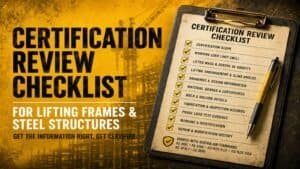
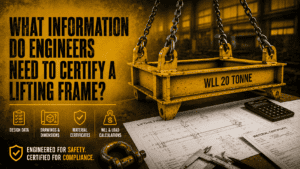
Certification Review Checklist for Lifting Frames and Steel Structures
A practical certification review checklist for lifting frames and steel structures, covering the drawings, WLL, load data, material records, weld...
Read More → 
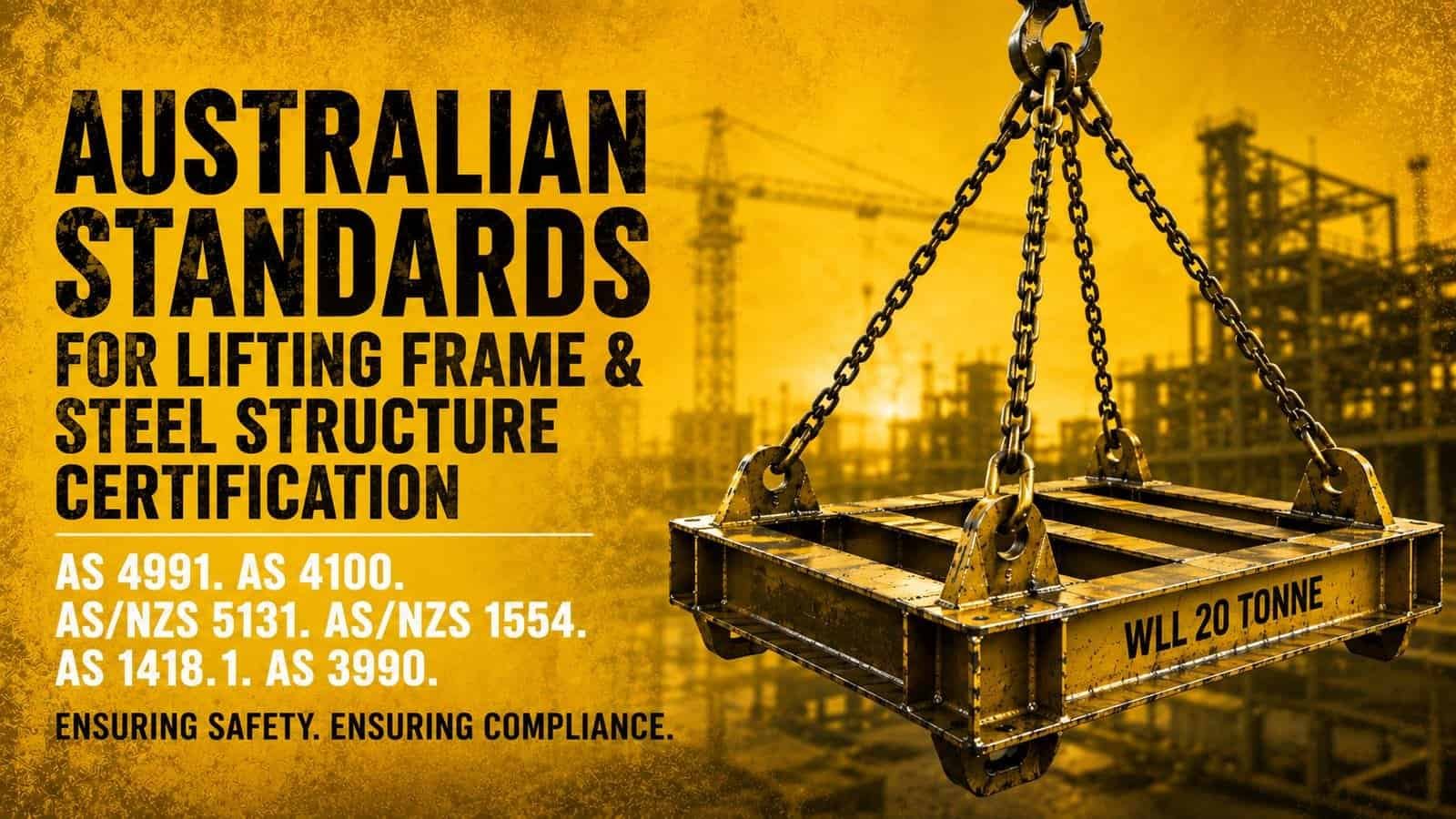
Lifting frame certification is rarely based on one standard alone. A custom lifting frame may need to be assessed as a lifting device, a fabricated steel structure, a welded assembly, a crane-interface item, and a site-critical piece of equipment. That is why understanding the relevant Australian Standards matters before fabrication, proof testing, site delivery or client handover.
For many industrial, mining, manufacturing and construction projects, certification is not just a final document. It is the evidence that the lifting frame has been designed, fabricated, inspected, tested and marked for the intended lifting duty.
This guide explains the key Australian Standards commonly considered for lifting frame and steel structure certification, including AS 4991, AS 4100, AS/NZS 5131, AS/NZS 1554, AS 1418.1 and AS 3990. It is written for fabricators, manufacturers, OEMs, project managers, equipment suppliers and site teams that need lifting equipment accepted without last-minute compliance issues.
AS 4991 is commonly the key standard for lifting devices, including many lifting frames, lifting beams, spreader beams and below-the-hook lifting attachments.
AS 4100 may apply where the lifting frame is assessed as a load-carrying steel structure.
AS/NZS 5131 is relevant to fabrication, documentation, traceability, inspection, test planning, surface treatment and steelwork quality.
AS/NZS 1554 is relevant to structural steel welding.
AS 1418.1 may be relevant where the lifting device interfaces with cranes, hoists, hooks or crane-type equipment.
AS 3990 may be relevant where the item is treated as mechanical equipment steelwork or where a project specification nominates it.
A lifting frame is often more than a simple fabricated steel item. It may include structural members, lifting lugs, welds, bolted connections, shackles, spreader elements, connection plates, stiffeners, coating systems and marked lifting points.
When that frame is connected to a crane, hoist, hook or sling system, the engineering questions become broader than “is the steel strong enough?”
The engineer may need to confirm:
That is why lifting frame certification commonly sits across multiple Australian Standards. AS 4991 may address the lifting device requirements, but AS 4100 may be needed for the steel structure design checks, AS/NZS 5131 may be needed for fabrication documentation, and AS/NZS 1554 may be needed for welding requirements.
AS 4991 is commonly the first standard considered for lifting devices. For many custom lifting frames, lifting beams, spreader beams, lifting lugs and below-the-hook lifting devices, it is a critical part of the certification basis.
AS 4991 is relevant because it addresses the lifecycle of a lifting device, including design, verification, proof loading, marking, inspection, maintenance and repair records.
For lifting frame certification, AS 4991 is commonly relevant to:
The practical takeaway is simple: if the item is intended to lift, support or suspend a load below a crane hook, AS 4991 is usually one of the first standards an engineer will consider.
Proof load testing is often misunderstood. A proof test does not automatically replace engineering certification. It is one part of the verification evidence.
For general application lifting devices, AS 4991 gives proof load requirements based on the Working Load Limit or rated capacity. The proof load value changes depending on the rated capacity range.
The test arrangement also matters. The proof load should be applied in a way that represents the intended service arrangement, while minimising dynamic effects. The test should include appropriate hold time, measurement of deformation and post-test examination by a competent person.
That means a useful proof load test report should clearly record:
A test certificate without a clear test arrangement, load value, inspection result or device identification may not be enough to support certification.
Marking is a common reason lifting devices are delayed or rejected at site acceptance.
For a lifting frame, the marking should align with the certified configuration. Depending on the device, markings may include the manufacturer or supplier identification, identification number, tare mass, Working Load Limit or rated capacity, and configuration ratings where the device can be used in more than one configuration.
For lifting beams and similar devices, sling angle information may also be relevant where the design depends on the maximum permissible included sling angle.
Incorrect markings create risk because site personnel may use the frame in a configuration that was never assessed.
Send your drawings, lifting arrangement, WLL and proof test information through the contact page. We can review the information and confirm the likely certification pathway.
AS 4100 is relevant where the lifting frame is assessed as a load-carrying steel structure. Many custom lifting frames are fabricated from structural steel members, plates, stiffeners, welds and bolted connections, so AS 4100 can become part of the design basis.
AS 4100 may be used to check:
For lifting frames, AS 4100 is especially important where the frame includes structural members that transfer load between lifting points and the lifted item. A lifting lug may be strong enough on its own, but the surrounding frame still needs to carry the load into the rest of the structure.
One of the most important practical lessons from AS 4100 is that drawings and specifications matter. Engineering certification depends on clear design information.
The engineer may need to see:
If the drawing says “certified to 10 tonne” but does not show weld sizes, steel grades, lug dimensions or sling angles, the certification process will usually require more information.
AS/NZS 5131 is highly relevant to lifting frame certification because design capacity is only useful if the fabricated item matches the design assumptions.
For structural steelwork, AS/NZS 5131 addresses the practical evidence needed to support fabrication quality and compliance. This includes documentation, traceability, welding controls, bolting, tolerances, inspection, test planning, surface treatment and nonconformance management.
For lifting frames, AS/NZS 5131 may be relevant to:
This matters because many certification delays happen after fabrication, when the engineer asks for evidence that should have been collected earlier.
Material traceability gives the engineer confidence that the steel used in the lifting frame matches the material properties used in the design assessment.
For a lifting frame, material evidence may include:
If material certificates are missing, the engineer may need to apply conservative assumptions, request material testing, limit the certification scope, or require additional verification.
An Inspection and Test Plan, often called an ITP, helps define what must be checked during fabrication and when hold points apply.
For lifting frame certification, an ITP may include:
A clear ITP reduces rework because it helps prevent critical inspections from being missed before painting, galvanizing or delivery.
AS/NZS 1554 is the structural steel welding standard series commonly linked to fabricated steel lifting frames through AS/NZS 5131.
Welding is critical in lifting frame certification because lifting frames often rely on welded lifting lugs, welded stiffeners, welded end plates, welded member connections and welded bracing.
The engineer may need to verify:
Small changes in weld size, weld length or weld location can affect the capacity of the lifting frame. This is why welding details should be shown clearly on the fabrication drawings before work begins.
Practical point: do not wait until the frame is painted or galvanized before asking for certification. Weld inspection and NDT are usually easier, cleaner and more reliable before surface treatment.
AS 1418.1 may be relevant where a lifting frame interfaces with cranes, hoists, winches or crane-type equipment.
It may not always be the main standard for the lifting frame itself, but it can influence the certification basis where the lifting device forms part of a crane-related system or where the project specification calls it up.
AS 1418.1 may be relevant to:
In practical terms, the crane being certified does not automatically certify the lifting frame below it. The crane, hook, rigging gear and lifting device each need to be suitable for their part of the lift.
AS 3990 may be relevant where the lifting frame forms part of mechanical equipment steelwork or where the client specification nominates AS 3990 as the design basis.
This can occur in mining, processing, materials handling and industrial equipment projects where the frame supports or interfaces with mechanical equipment.
AS 3990 may be relevant to:
AS 3990 should not be assumed for every lifting frame. The correct design basis depends on the item, the project specification, the client requirement and the engineer’s assessment.
| Item | Commonly Relevant Standards | Why They Matter |
|---|---|---|
| Custom lifting frame | AS 4991, AS 4100, AS/NZS 5131, AS/NZS 1554 | Usually a lifting device and a fabricated steel structure. |
| Spreader beam | AS 4991, AS 4100, AS/NZS 5131, AS/NZS 1554 | Requires lifting device checks, steel member checks and weld verification. |
| Lifting lug or padeye | AS 4991, AS 4100, AS/NZS 1554 | Requires checks on lug geometry, welds, local frame capacity and load direction. |
| Skid frame with lifting points | AS 4100, AS/NZS 5131, AS/NZS 1554, AS 4991 where applicable | May be both a support frame and a lifting device. |
| Mechanical equipment frame | AS 4100 or AS 3990, AS/NZS 5131, AS/NZS 1554 | Depends on whether it is treated as structural steelwork or mechanical equipment steelwork. |
| Existing or modified lifting frame | AS 4991, AS 4100, AS/NZS 5131, AS/NZS 1554 | Requires review of original certification, condition, repairs, modifications and current intended use. |
No. A proof load test does not replace engineering certification.
A proof load test confirms that one physical item performed under a specific test setup. It does not automatically confirm every design case, sling angle, centre of gravity condition, fatigue condition, weld detail, material assumption or future configuration.
Engineering certification defines the design basis. Proof testing may then provide supporting verification evidence.
A strong certification process usually follows this order:
The exact document list depends on the item and certification scope, but a strong submission usually includes the following.
Most certification delays are caused by missing, unclear or inconsistent information.
Common problems include:
These delays are usually avoidable if the standards and documentation requirements are confirmed before fabrication begins.
Fabricators can reduce risk by involving the certification engineer early.
Before fabrication, provide:
Early review can identify missing information, insufficient lug details, weld issues, member capacity concerns, marking requirements and proof test requirements before the item is built.
Existing lifting frames can sometimes be certified, but the engineer needs evidence of what the frame is, what it is made from, how it was fabricated and what condition it is in.
For existing frames, provide:
If documentation is missing, the engineer may need measurements, NDT, material verification, conservative design assumptions or a new proof test before certification can proceed.
StructCert provides engineering certification support for lifting frames, lifting lugs, spreader beams, fabricated steel structures and industrial equipment frames. Send your drawings, load information and lifting arrangement through the contact page and we will organise a free certification call.
For more information about structural certification and lifting device sign-off, see:
AS 4991 is commonly relevant because lifting frames are often lifting devices. AS 4100, AS/NZS 5131 and AS/NZS 1554 may also apply where the lifting frame is fabricated from structural steel and includes welded or bolted structural members.
Not always. AS 4991 may cover the lifting device requirements, but a steel lifting frame may still need structural steel member checks, fabrication documentation, welding controls and inspection records under AS 4100, AS/NZS 5131 and AS/NZS 1554.
AS 4100 may apply where the lifting frame is assessed as a load-carrying steel structure. It is relevant for member capacity, connection design, construction specifications, material assumptions and fabrication requirements.
AS/NZS 5131 is used for structural steelwork fabrication and erection. It addresses documentation, traceability, welding, tolerances, inspection, testing, fasteners, coatings and nonconformance.
No. A proof load test provides evidence for a specific item under a specific test arrangement. Engineering certification still needs to define the design basis, load case, materials, welds, inspection requirements, markings and limitations.
Sometimes. Existing lifting frames may be certified if sufficient evidence is available or can be created through measurement, inspection, material verification, NDT, proof testing and engineering assessment.
Markings should clearly identify the lifting device and its certified rating. Depending on the device, this may include manufacturer identification, identification number, tare mass, Working Load Limit or rated capacity, configuration ratings and sling angle limitations where applicable.
Lifting frame certification is not about picking one standard and ignoring the rest. The correct certification basis depends on the device, the load case, the lifting arrangement, the steelwork, the fabrication process, the welds, the proof testing and the site requirements.
For many lifting frames, the key standards include AS 4991 for lifting devices, AS 4100 for steel structural design, AS/NZS 5131 for fabrication and documentation, AS/NZS 1554 for welding, AS 1418.1 where crane interfaces are relevant, and AS 3990 where mechanical equipment steelwork is the selected design basis.
The best way to reduce risk is to confirm the applicable standards before fabrication, proof testing or site delivery.
Submit your drawings, load data and lifting arrangement through the contact page. We will review the information and organise a free certification call.