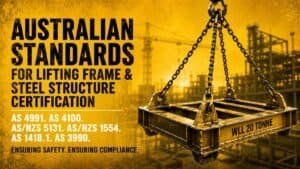
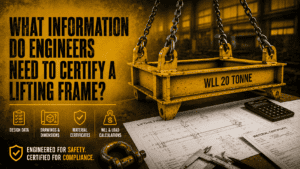
Australian Standards for Lifting Frame and Steel Structure Certification
Learn which Australian Standards apply to lifting frame and steel structure certification, including AS 4991, AS 4100, AS/NZS 5131 and...
Read More → 
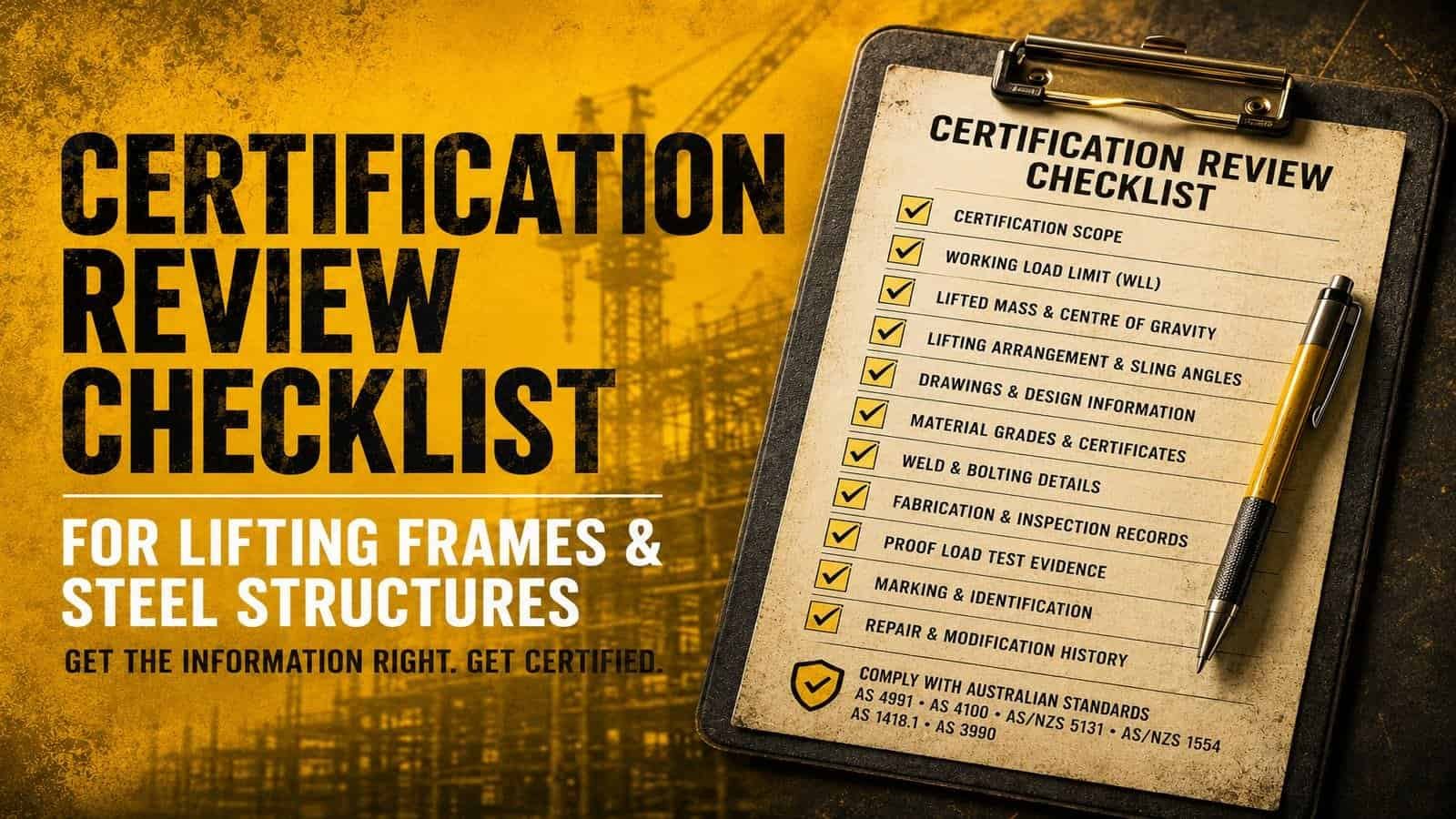
A certification review checklist helps fabricators, manufacturers, project engineers and site teams prepare the right information before asking an engineer to certify a lifting frame, lifting device or fabricated steel structure. The better the information pack, the faster the engineering review can usually move.
For lifting frames and steel structures, certification is not just a final signature. It is a documented engineering review of the design basis, load path, material assumptions, fabrication quality, weld details, inspection evidence, proof test results and markings for the item being certified.
This guide explains what to include in a certification review checklist for lifting frames, spreader beams, lifting lugs, skid frames, handling frames and fabricated steel structures. It focuses on the Australian Standards commonly relevant to this type of work, including AS 4991 for lifting devices, AS 4100 for steel structures, AS/NZS 5131 for structural steelwork fabrication and erection, AS/NZS 1554 for welding, AS 1418.1 where crane interfaces are relevant, and AS 3990 where mechanical equipment steelwork is the selected design basis.
A strong certification review checklist should include the certification scope, drawings, Working Load Limit, lifted mass, centre of gravity, lifting point layout, sling angles, material grades, mill certificates, weld details, bolting details, fabrication records, inspection records, proof load test evidence, marking details and any repair or modification history.
For lifting frames, AS 4991 is usually a key standard because the item is often a lifting device. For steel structures, AS 4100 and AS/NZS 5131 are commonly relevant because the item may also be a fabricated steel structure with traceability, welding, inspection and quality documentation requirements.
Most certification delays do not happen because the engineering is impossible. They happen because important information is missing, unclear or inconsistent.
A fabricator may have built a lifting frame but not recorded the material grade. A manufacturer may know the equipment mass but not the centre of gravity. A site team may have proof load test records but no drawings showing the tested configuration. A project manager may have a certificate for the original frame, but the lifting lugs have since been modified.
Those gaps matter because a certification engineer needs to define exactly what is being certified and what evidence supports that certification.
A proper checklist helps answer questions such as:
The goal is simple: remove uncertainty before it becomes a delay, rejection or safety risk.
Before building a checklist, it helps to understand which standards may drive the information required.
| Standard | Why It May Matter | Checklist Impact |
|---|---|---|
| AS 4991 Lifting devices | Commonly relevant to lifting frames, spreader beams, lifting beams and below-the-hook lifting devices. | Drives WLL, proof loading, markings, inspection, maintenance and repair record requirements. |
| AS 4100 Steel structures | Relevant where the lifting frame or fabricated item is assessed as a load-carrying steel structure. | Drives member checks, connection checks, design loads, steel grades and construction specification details. |
| AS/NZS 5131 Structural steelwork, fabrication and erection | Relevant to fabrication quality, traceability, inspection and documentation for structural steelwork. | Drives material records, ITPs, welding documentation, tolerances, inspection and surface treatment records. |
| AS/NZS 1554 Structural steel welding | Relevant to welded steel lifting frames, lugs, padeyes and connection details. | Drives weld categories, weld sizing, welding procedure records, welder qualification and weld inspection evidence. |
| AS 1418.1 Cranes, hoists and winches | May be relevant where the certified item interfaces with crane, hoist or winch equipment. | Can affect crane interface, rated load and associated equipment considerations. |
| AS 3990 Mechanical equipment steelwork | May be relevant where the frame is treated as mechanical equipment steelwork or the project specification nominates it. | Can affect material, design and steelwork certification requirements for mechanical equipment frames. |
The correct standards depend on the item, the load case, the site requirement and the project specification. Do not assume one standard covers everything.
The checklist below is written for practical use. It can be used before contacting an engineer, before fabrication, before proof testing or before submitting an item to a client or site.
This minimum information may not be enough to complete certification, but it is usually enough for an engineer to identify the next required steps.
The first checklist item is the certification scope. This defines what the engineer is being asked to review.
Scope issues are common. A client may ask for a lifting frame to be certified, but the project team may not know whether that includes the shackles, slings, crane hook, equipment being lifted, proof test arrangement or only the fabricated frame.
Define the scope clearly before the review begins.
Checklist tip: if the lifting frame can be used in more than one way, list each configuration separately. Different lift points, sling angles or centres of gravity can change the certification basis.
The Working Load Limit, often shortened to WLL, is one of the most important inputs for lifting frame certification. AS 4991 uses WLL or rated capacity in relation to proof loading and marking requirements.
The WLL should not be guessed after fabrication. It should be supported by engineering assessment, load information, material assumptions, fabrication evidence and, where required, proof testing or alternative verification.
Where the frame is already marked, provide a photo of the marking plate or tag. The engineer will need to confirm whether the marking matches the certified configuration.
A certification review cannot be completed properly without understanding the applied load.
For lifting frames, the engineer needs the lifted item mass, the self-weight of the lifting frame, the load distribution and the centre of gravity. The centre of gravity is especially important for multi-point lifts because load sharing is rarely perfect.
If the centre of gravity is unknown, disclose that early. The engineer may need to make conservative assumptions, request manufacturer information or recommend a different verification method.
The lifting arrangement controls how load enters the frame. A frame lifted vertically through one central point behaves differently from a frame lifted using four angled sling legs.
Sling angle matters because angled slings introduce horizontal force components into lifting lugs, welds and members. The same total load can produce very different forces depending on the lift geometry.
For lifting beams and spreader arrangements, the certified sling angle may need to be reflected in the markings or operating instructions.
Send your drawings, WLL, lifted mass and lifting arrangement through the contact page. We can review the information and confirm what is missing before certification proceeds.
Drawings are the backbone of a certification review. A photo can help, but it cannot replace a drawing that defines geometry, member sizes, plate thicknesses, welds and connection details.
AS 4100 places importance on design information and construction specification details. AS/NZS 5131 also relies on shop detail documentation and traceability so the fabricated item can be checked against the intended design.
If drawings do not match the fabricated item, provide marked-up as-built drawings or photos showing the difference. Undocumented changes can delay certification.
Material properties affect design capacity. The engineer needs to know what steel was assumed in the design and what steel was actually used in the fabricated item.
AS/NZS 5131 includes requirements for material documentation and traceability. For fabricated steelwork, this can include test certificates, mill certificates, grade identification and a tracking system depending on the construction category and project requirements.
Checklist tip: if material certificates are missing, tell the engineer at the start. Certification may still be possible, but additional testing, conservative assumptions or limits on the certification scope may be required.
Welds and bolted connections often control the capacity of lifting frames. A large steel member is not useful if the welds or bolts transferring the load are inadequate.
AS/NZS 5131 requires structural steel welding to comply with the relevant part of AS/NZS 1554 and requires welding details such as weld category, size, type and extent to be shown in the shop detail drawing set.
For lifting frames subject to vibration or repeated use, connection details should be reviewed carefully. Do not change welds, bolt grades or connection details without engineering review.
Fabrication quality records help prove that the fabricated item matches the design basis. This is where AS/NZS 5131 becomes especially relevant.
For structural steelwork, AS/NZS 5131 covers preparation, assembly, fabrication, welding, mechanical fastening, surface treatment, tolerances and inspection requirements. It also links documentation requirements to the construction category.
Inspection records are especially useful for existing frames, where the certifying engineer may not have been involved before or during fabrication.
For lifting devices, proof load evidence may be required or may form part of the verification basis. AS 4991 provides proof loading requirements for general application lifting devices and includes criteria relating to proof load value, hold time, permanent deformation and post-test inspection.
Proof testing should be planned, not improvised. The test arrangement should represent the intended service arrangement as closely as practical.
A proof load certificate with no clear link to the drawing, serial number, test setup or certified configuration may not be enough for engineering sign-off.
Markings connect the physical item to the certification documentation. If the marking is wrong, missing or unclear, the item may be used outside its certified limits.
For lifting devices, AS 4991 includes marking requirements relevant to manufacturer identification, identification number, tare mass where applicable, WLL or rated capacity, and configuration ratings where multiple configurations exist.
The certification report and the physical marking should tell the same story.
Existing lifting frames and steel structures need extra care. A frame that was certified years ago may have been damaged, repaired, modified, overloaded, corroded or used in a different configuration.
AS 4991 addresses repair records for lifting devices. AS/NZS 5131 also addresses modification and documentation requirements for structural steelwork. Repairs and modifications should not be treated as workshop-only decisions when they affect the load path.
If the current use differs from the original certification, the frame should be reviewed before use.
Send photos, drawings, previous certification and current intended use through the contact page. We can identify the evidence needed for a certification review.
Certification delays usually come from preventable information gaps.
The best way to avoid these problems is to involve the certifying engineer early, before fabrication, coating, proof testing or site delivery.
You do not need every document before contacting an engineer. The checklist is a guide, not a barrier.
Start with the basics:
From there, the engineer can identify what is missing and whether the certification can proceed as-is, needs further evidence, or requires design changes.
For more information about certification and lifting device sign-off, see:
A certification review checklist is a structured list of information needed before an engineer can review a lifting frame, lifting device or steel structure for certification. It usually covers drawings, loads, materials, welds, inspection records, proof testing and markings.
The most important information is the Working Load Limit or rated capacity, lifted mass, centre of gravity, lifting arrangement, sling angles, drawings, material grades and weld details.
AS 4991 is commonly relevant to lifting frames because they are often treated as lifting devices or below-the-hook lifting attachments. The final standard selection depends on the exact item and certification scope.
AS 4100 may apply where the lifting frame is assessed as a load-carrying steel structure. It is commonly relevant for member capacity, connection capacity and steel design assumptions.
AS/NZS 5131 adds fabrication, traceability, inspection, welding, bolting, tolerances, surface treatment and quality documentation requirements for structural steelwork.
Sometimes. Existing lifting frames may be certified if enough evidence is available or can be developed through measurement, inspection, material verification, NDT, proof testing or engineering assessment.
No. A proof load test provides evidence for a specific test arrangement. Engineering certification still needs to confirm the design basis, load case, materials, welds, markings, inspection evidence and certification limits.
A certification review checklist helps prevent delays, rework and rejected submissions. For lifting frames and steel structures, the checklist should cover much more than a drawing and a requested rating.
A complete review pack should define the certification scope, applicable standards, WLL, load data, centre of gravity, lifting arrangement, drawings, materials, welds, bolting, fabrication records, inspection evidence, proof load records, markings and repair history.
For many projects, AS 4991, AS 4100, AS/NZS 5131 and AS/NZS 1554 all play a role. The right combination depends on the item and the intended use.
If you are preparing a lifting frame, lifting lug, spreader beam, skid frame or fabricated steel structure for certification, the best time to start is before fabrication or proof testing.
Send your drawings, load data, photos or proof test records through the contact page. StructCert will review the information and organise a free certification call.